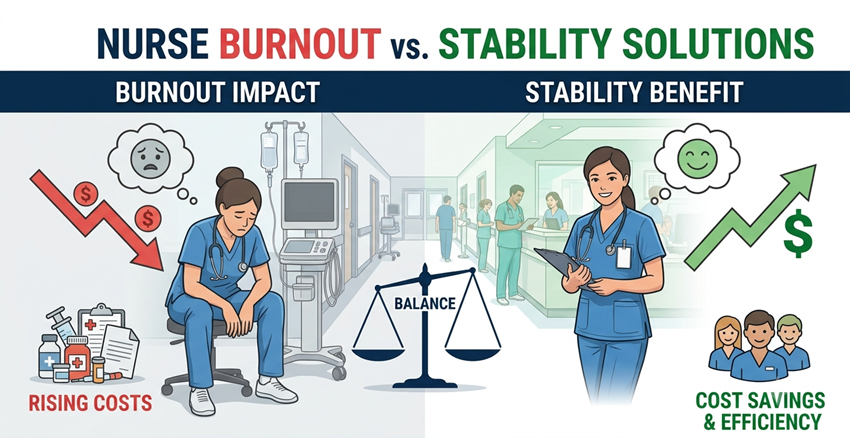
When permanent staffing levels dip, the traditional financial response has often been to freeze hiring, mandate overtime, or stretch existing staff thin to contain immediate labor costs. This approach relies on a major financial blind spot. Looking strictly at hourly wage line items ignores the compounding, hidden liabilities that follow chronic understaffing.
To build a truly resilient workforce, healthcare administrators must look beyond surface-level hourly rates. Conducting a comprehensive per diem medical staffing cost analysis reveals that the premium cost of utilizing external clinical resources is frequently lower than the total financial damage caused by permanent staff turnover, sign-on bonuses, and overtime burnout.
The Financial Reality of the Cost of Understaffing in Hospitals
The financial impact of an open nursing position extends far beyond a vacant slot on a shift schedule. When a unit is short-staffed, the remaining clinical team must absorb the excess workload. This strain triggers a predictable, expensive downward spiral that impacts both clinical outcomes and fiscal health.
According to the NSI National Health Care Retention and Staffing Report, the average cost of turning over a single registered nurse stands at more than $52,000. For a mid-sized hospital system losing dozens of nurses annually, this represents millions of dollars in unbudgeted losses draining the bottom line.
When you factor in the expense of recruiting, onboarding, and training a replacement, alongside the temporary reliance on crisis rates, the true cost of understaffing in hospitals becomes clear. Operating with a permanent shortage does not save money. It simply shifts the expense from a predictable, strategic operational line item to a highly volatile, reactive emergency expense.
Breaking Down the Expenses of the Understaffing Cycle
To understand why a strategic partnership can protect a hospital budget, administrators must map out the exact costs generated by an overworked, understaffed department. These costs fall into three major financial categories.
Compounding Overtime and Premium Pay
Stretching a core workforce requires relying heavily on overtime pay. While paying time-and-a-half to an internal employee might seem more economical than paying an agency rate, the financial math changes when that overtime becomes a permanent fixture. Continuous overtime leads straight to physical and mental exhaustion, which directly drives up clinical error rates, absenteeism, and workers' compensation claims.
The Recruitment and Sign-On Bonus Carousel
As burnout drives permanent staff out the door, human resources departments are forced into an aggressive, expensive recruitment cycle. Hospitals frequently deploy five-figure sign-on bonuses, relocation stipends, and retention incentives just to attract applicants. These upfront cash outlays strain current cash flow without guaranteeing long-term employee retention.
Lost Bed Capacity and Deferred Revenue
Perhaps the most damaging financial consequence of severe understaffing is the forced reduction of operational capacity. When a hospital cannot meet safe nurse-to-patient ratios, it must close beds, divert emergency department traffic, and delay elective surgical procedures. The revenue lost from a single diverted surgical patient can completely wipe out weeks of theoretical savings gained by keeping labor costs artificially low.
Calculating the True Nurse Staffing Agency ROI
When reviewing potential healthcare staffing solutions, administrators often hesitate at the initial bill rate of an agency partner. This hesitation stems from an unequal comparison. Comparing an agency hourly rate directly to a permanent nurse’s base hourly wage ignores the extensive overhead wrapped into permanent employment.
A comprehensive calculation of permanent labor costs must include mandatory benefits, health insurance, paid time off, retirement contributions, professional liability insurance, and continuing education. When these hidden costs are factored in, the true cost of an internal employee is often 1.3 to 1.5 times their base hourly rate.
By contrast, an external partnership transfers these overhead burdens entirely to the provider. Evaluating a nurse staffing agency ROI requires weighing the total cost of ownership. Partnering with a reliable organization allows a hospital to pay exclusively for productive clinical hours worked, eliminating the financial drain of idle time, paid leave, and long-term benefit liabilities.
Strategic Flexibility Through Per Diem Partnerships
Maintaining a rigid, full-time workforce designed to handle peak patient volumes is financially unsustainable during low-census periods. Conversely, staffing only for baseline volumes leaves a facility dangerously exposed during seasonal surges or unexpected spikes in patient acuity.
Strategic utilization of per diem healthcare professionals provides the operational elasticity required to navigate these fluctuations smoothly. Rather than lock a facility into long-term payroll commitments, a per diem model allows senior leadership to scale nursing teams up or down in real time based on actual patient volume and acuity data.
At Interim HealthCare, we provide flexible, reliable healthcare staffing solutions that align seamlessly with your operational demands. Our carefully vetted clinical staff steps into your units seamlessly, maintaining your high standards of patient care while protecting your core staff from the exhausting shifts that lead to resignation letters.
Safeguarding Patient Care and Clinical Quality Metrics
Beyond the direct labor expenditures, understaffing heavily impacts a hospital’s financial performance through quality-of-care metrics and federal reimbursement penalties. Value-based purchasing programs and insurance readmission penalties tie a significant portion of hospital revenue directly to patient outcomes and satisfaction scores.
When nurses are balanced across too many patients, the quality of care inevitably declines. Chronic shortages correlate directly with an increase in hospital-acquired conditions, medication administration errors, patient falls, and healthcare-associated infections.
Furthermore, exhausted nursing teams have less time to dedicate to patient education and thorough discharge planning. This leads directly to lower patient satisfaction scores and higher 30-day readmission rates, both of which trigger substantial financial penalties from Medicare and private payers. Investing in strategic per diem coverage protects your clinical outcomes, preserves your institutional reputation, and safeguards your federal reimbursements.
Restoring Balance to Your Bottom Line
Managing a healthcare facility requires balancing fiscal discipline with clinical excellence. Viewing temporary or per diem clinical support as an expensive luxury is a fundamental financial miscalculation. In reality, a structured, proactive staffing partnership is an essential risk-management tool that stabilizes operational expenses, protects your permanent workforce, and preserves your hospital's revenue-generating capacity.
By integrating flexible medical staffing models into your overarching labor strategy, you can break the expensive, exhausting cycle of nurse burnout, permanent turnover, and costly recruitment campaigns. You gain the ability to adjust your workforce to meet patient needs precisely, without overextending your budget or your people.
At Interim HealthCare, we are dedicated to helping healthcare institutions find this critical operational equilibrium. Our specialized healthcare staffing solutions ensure that you always have access to top-tier, fully credentialed nursing professionals exactly when you need them.
Ready to stabilize your workforce expenditures and protect your clinical teams from burnout? Contact your local Interim HealthCare office today to discuss a customized staffing partnership built for your facility's unique operational needs.
Want to optimize your healthcare operations?