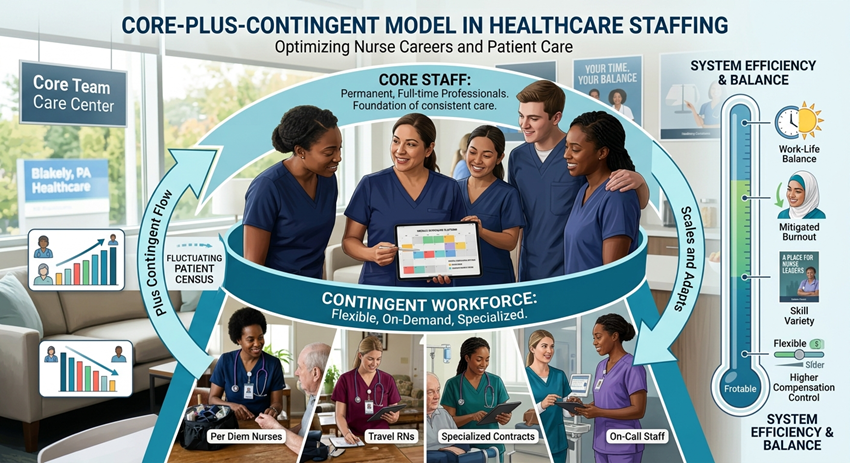
When patient census drops, overstaffed departments experience inflated labor costs that strain operating budgets. Conversely, unexpected spikes in hospital admissions leave units understaffed, forcing permanent team members to take on excessive workloads. According to healthcare industry research, labor expenses account for up to 55 percent of total operating budgets in health systems, making labor allocation a critical factor in financial sustainability.
Forward-thinking health systems are moving away from all-or-nothing hiring strategies. By implementing dynamic healthcare staffing models, executive leadership teams are finding a balanced path that aligns clinician availability with actual patient care demands.
The Fundamentals of the Core-plus-Contingent Strategy
The core-plus-contingent framework restructures how healthcare organizations deploy clinical talent. Rather than staffing a department to meet peak capacity with permanent employees, leadership establishes a streamlined core staff sized to handle average baseline census needs.
To manage patient volume spikes, planned medical leaves, and seasonal demand changes, health systems integrate a flexible layer of contingent professionals. This secondary layer includes per diem nurses, contract clinicians, and specialized allied health personnel supplied through trusted staffing partners.
Operating within a core-plus-contingent framework provides significant operational advantages:
Protects core staff from excessive overtime demands and chronic workplace exhaustion
Prevents financial losses associated with paying full-time salaries during low-census periods
Maintains ideal nurse-to-patient ratios even during sudden admission surges
Enables healthcare facilities to scale specialized clinical services up or down as community needs evolve
This blended operational architecture creates a resilient workforce capable of adapting to real-time volume fluctuations without sacrificing patient care quality.
Financial Optimization and Overhead Protection
Managing labor budgets requires balancing fixed overhead with variable operational costs. Relying solely on full-time employees forces healthcare facilities to carry substantial fixed overhead expenses year-round. These costs include long-term benefit packages, paid time off accruals, retirement contributions, and onboarding investments.
During periods of low patient census, fixed employment costs remain static while facility revenue declines. This creates immediate financial pressure on operating margins.
Adopting strategic a healthcare staffing agency transforms a portion of fixed labor expenses into flexible operational costs. Contingent clinicians are brought in when patient care volume demands them, aligning labor expenditures directly with incoming facility revenue. During low-volume months, healthcare facilities naturally scale back contingent utilization, preserving capital without resorting to disruptive lay-offs or hours reductions for core team members.
Mitigating Burnout and Protecting Core Retention
Burnout remains a major driver of turnover among registered nurses, nurse practitioners, and allied health professionals. When hospital units face persistent staffing shortages, permanent employees bear the burden. Mandatory overtime, heavy patient loads, and missed breaks compromise employee morale and accelerate staff departures.
A core-plus-contingent staffing strategy creates a vital relief valve for permanent staff. When patient admissions rise, contingent nurses step in to absorb the additional workload. This support ensures core team members can maintain manageable patient assignments and take earned time off without guilt.
Demonstrating respect for work-life balance helps health systems retain their experienced core personnel. Retaining skilled core clinicians reduces expensive recruitment costs and preserves institutional knowledge within care teams.
Enhancing Clinical Agility and Specialized Coverage
Healthcare demands are rarely uniform across all units. A hospital might experience a surge in surgical volume while pediatric admissions remain steady. A long-term care facility might need immediate coverage for specialized memory care or rehabilitation therapy.
Maintaining full-time, specialized clinicians on standby for every scenario is financially impractical. Integrating flexible contingent resources gives nursing directors access to a broad pool of qualified specialists on demand.
Agile staffing models allow health systems to tap into specialized expertise when specific patient needs arise. Whether filling gaps in critical care units, home health services, or outpatient clinics, contingent staff help maintain seamless clinical operations across every care setting.
Implementing Modern Healthcare Staffing Solutions
Transitioning to a core-plus-contingent model requires careful planning, robust technology integration, and dependable clinical partners. To successfully execute this approach, healthcare leadership teams focus on key operational practices:
Data-Driven Capacity Planning
Analyzing historical admission trends, seasonal illness patterns, and local demographic data helps nurse executives forecast baseline core staffing needs accurately. Predictive analytics identify peak volume windows well in advance, allowing managers to schedule contingent support proactively.
Seamless Orientation and Onboarding
Ensuring rapid assimilation of contingent nurses requires standardized orientation workflows. Clear communication regarding unit protocols, electronic health records platforms, and facility procedures allows contract clinicians to begin delivering effective care from day one.
Establishing Trusted Agency Partnerships
The success of a contingent staffing strategy depends on the reliability and competence of the supplemental workforce. Partnering with reputable agencies ensures that incoming clinicians possess verified credentials, thorough background vetting, and high clinical competency.
Partnering with Interim HealthCare for Strategic Talent Management
Building a flexible, high-performing workforce requires an experienced healthcare partner who understands the complexities of clinical operations. Interim HealthCare provides comprehensive workforce management strategies designed to support health systems, hospitals, and outpatient facilities in achieving operational balance.
Through our tailored healthcare staffing solutions, Interim HealthCare supplies vetted registered nurses, licensed practical nurses, certified nursing assistants, and allied health professionals across per diem, short-term contract, and specialized facility roles. Our local clinical leaders work alongside your management team to build a custom staffing framework that protects your operating margins, supports your core team, and ensures uncompromised patient care.
Position your organization for long-term operational success with flexible staffing strategies. Learn more about our comprehensive health care staffing services, or contact your local Interim HealthCare office today to connect with our workforce strategy team.