Defining Clinical Home Health
Clinical home health is specialized, short-term medical care ordered by a physician and designed to treat a specific medical condition, illness, or injury. Because it involves clinical interventions, this type of care must be delivered by licensed healthcare professionals, such as registered nurses, physical therapists, occupational therapists, speech-language pathologists, or medical social workers.
The primary goal of home health is to help an individual recover, regain independence, or manage a chronic condition effectively from the comfort of home. Common scenarios that trigger home health services include surgical rehabilitation, wound care management, intravenous therapy administration, and physical therapy following a stroke or severe fall. Because these services are medically necessary, they are typically covered by Medicare, Medicaid, or private health insurance, provided the patient meets specific eligibility criteria, including being considered homebound. When evaluating home health care vs personal care, it becomes clear that home health focuses strictly on clinical outcomes rather than long-term assistance with everyday lifestyle habits.
Understanding Non-Medical Home Care
In contrast, non-medical home care is primarily custodial and focuses on helping individuals manage the activities of daily living so they can remain safely and independently in their own homes. This type of service is often referred to as supportive care, personal care, or companionship. Because these services do not involve medical administration or clinical procedures, they are performed by professional caregivers rather than licensed nurses or therapists.
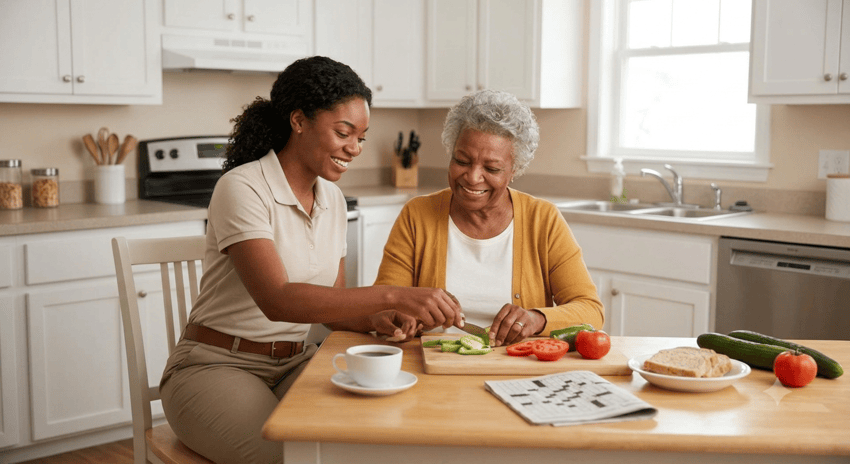
When a family contracts with a non medical home care agency, the focus centers entirely on enhancing quality of life and managing the household. Caregivers provide crucial assistance with mobility, bathing, dressing, toileting, and transferring. They also manage light housekeeping, prepare nutritious meals, provide transportation to medical appointments, and offer vital companionship to combat senior isolation. This form of care is sometimes labeled as private duty home care because it is typically paid for out-of-pocket by families or through long-term care insurance policies, rather than traditional health insurance or standard Medicare. For families seeking reliable, long-term custodial care for seniors, this service provides the daily peace of mind needed to ensure a loved one is eating well, moving safely, and living in a clean environment.
The Key Differences: A Side-by-Side Analysis
Distinguishing the exact difference between home health and home care requires looking at four major categories: clinical necessity, staffing, duration, and funding sources.
Regarding clinical necessity, home health is entirely dependent on a medical prescription and a doctor-approved plan of care aimed at recovery or stabilization. Home care, however, requires no doctor's order and is determined entirely by the family based on the lifestyle preferences and safety needs of the individual.
Staffing represents another massive point of divergence. Home health utilizes highly trained clinical professionals who monitor vital signs, adjust medication dosages, and perform therapeutic exercises. Home care relies on compassionate, skilled caregivers who focus on the physical and emotional rhythms of daily life without performing clinical tasks.
The duration of these services varies substantially based on those underlying clinical goals. Home health is generally episodic and temporary, often lasting for a few weeks or months until a specific recovery metric is achieved or a wound heals. Conversely, home care is flexible and ongoing, ranging from a few hours a week to round-the-clock supervision over several years, scaling up or down as the natural process of aging occurs.
Financially, because home health is classified as essential medical care, insurance usually covers the total cost. Home care is predominantly funded privately, making budget planning an essential conversation for families analyzing long-term aging strategies.
How Interim HealthCare Bridges the Gap
Choosing between these two distinct pathways often creates a frustrating dilemma for families. Many seniors do not fit perfectly into just one category. A grandfather recovering from hip surgery might need a physical therapist to rebuild his strength through home health, but he also needs a caregiver to help him bathe, clean the kitchen, and cook dinner while his family is at work. Navigating two completely separate agencies to manage these overlapping needs adds unnecessary stress to an already challenging situation.
Interim HealthCare uniquely addresses this challenge by providing a nurse-led bridge that spans both service lines seamlessly. Because Interim operates as a comprehensive provider of both clinical care and supportive personal services, families do not have to choose one over the other or coordinate between different organizations. Every client relationship begins with a thorough assessment guided by a clinical nurse leader. This professional evaluation looks at the complete picture of the individual, analyzing both the clinical requirements and the personal, social, and emotional support needed to thrive at home.
By offering an integrated continuum of care, Interim HealthCare ensures that your services evolve smoothly as your loved one's needs or budgets shift. If a senior transitions out of their doctor-ordered home health window but still requires assistance with meal preparation and mobility, the care plan effortlessly shifts toward personal care without forcing the senior to build a relationship with an entirely new company. This unified approach eliminates gaps in communication, enhances safety, and maximizes the value of every dollar spent on care. Families gain a singular, trusted partner capable of answering any care question, whether it involves complex clinical nursing or simple, compassionate companionship. Contact a local Interim HealthCare office today to find out how we can help!