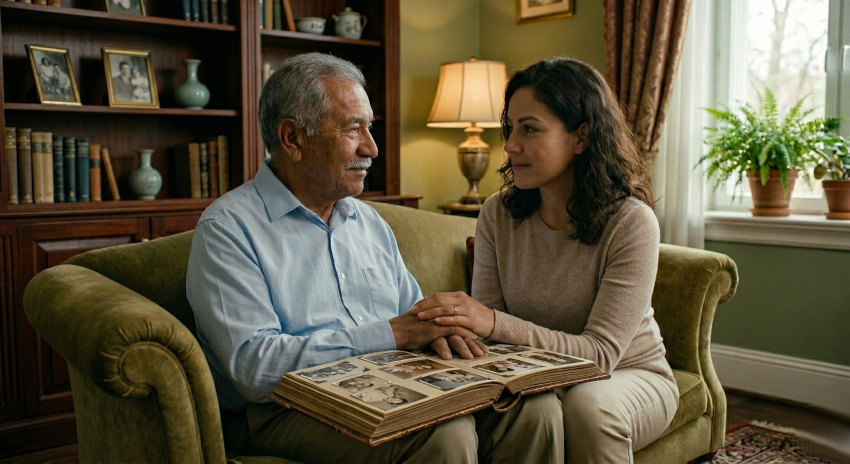
Dementia is a progressive condition that fundamentally alters how the brain processes, stores, and retrieves information. As the condition advances, verbal language often declines, creating significant communication barriers dementia introduces into everyday life. According to the Alzheimer’s Association, more than 11 million Americans provide unpaid care for a person with dementia, frequently citing communication challenges as one of the most emotionally taxing aspects of caregiving.
Learning how to talk to someone with dementia is not about correcting them or forcing them into our reality; it is about learning to step gently into theirs. By mastering practical techniques and adopting a compassionate approach, you can preserve your deep connection, de-escalate stressful behaviors, and maintain your loved one's dignity.
Understanding the Shift: How Dementia Alters Connection
To communicate effectively, it helps to understand what is happening behind the scenes. Dementia damages brain cells across multiple regions, including those responsible for language production (Broca’s area) and language comprehension (Wernicke’s area).
Because of this neurological damage, individuals may experience:
Anomia
Struggling to find the right word, often substituting a vague word or a completely incorrect phrase (e.g., calling a "refrigerator" a "cold box").
Logopenia
A gradual reduction in the amount of speech, where the person becomes increasingly quiet because generating sentences requires too much cognitive effort.
Loss of Comprehension
Difficulty processing complex sentences, fast speech, or abstract ideas.
Loss of Emotional Filter
Misinterpreting benign body language or tone of voice as hostile or aggressive, leading to defensive behavior.
Recognizing these symptoms as medical realities—rather than deliberate stubbornness—is the first step toward successful dementia caregiving.
Core Dementia Communication Tips for Every Stage
Whether your loved one is in the early, moderate, or late stage of cognitive decline, these fundamental dementia communication tips can dramatically improve the quality of your interactions and minimize daily friction.
Set the Stage and Eliminate Distractions
A brain coping with dementia lacks the ability to filter out background noise. Trying to have a conversation while the television is blaring, the dishwasher is running, or other family members are talking across the room is incredibly overwhelming.
- Action: Turn off the TV or radio. Move to a quiet, well-lit room. Sit or stand at eye level, rather than hovering over them, which can feel threatening or dominating.
Slow Down and Simplify
In our fast-paced world, we tend to speak quickly and bunch multiple thoughts together. For someone processing language at a fraction of their former speed, a rapid stream of words sounds like static.
- Action: Speak slowly, clearly, and in a calm, reassuring tone. Use short, direct sentences. Instead of saying, "It's time to get dressed, so go pick out a shirt from the closet and then we can head downstairs for breakfast," break it down into single steps: "Let's put on your shirt." Wait until that task is complete before offering the next direction.
Ditch the Open-Ended Questions
Asking "What would you like to eat for lunch today?" requires a level of abstract thinking and memory recall that may no longer be accessible. This can lead to anxiety or an abrupt "I don't know!"
- Action: Offer binary, visual, or single choices. Ask, "Would you like chicken or soup?" Better yet, hold up the two options so they can see them. If choices are still too overwhelming, reframe it as a pleasant statement: "Here is some delicious lunch for you."
Rely Heavily on Non-Verbal Cues
As verbal abilities decline, non-verbal communication becomes a lifeline. Studies show that individuals with advanced dementia rely overwhelmingly on the emotional energy, facial expressions, and body language of those around them.
- Action: Always approach from the front so you do not startle them. Smile warmly, maintain gentle eye contact, and use an open, relaxed posture. A gentle touch on the hand or shoulder can communicate safety and love far better than words ever could.
Overcoming Common Communication Barriers in Dementia Care
Being a dementia caregiver comes with specific roadblocks that test our patience. Knowing how to handle these moments gracefully can prevent emotional escalations.
When They Ask the Same Question Repeatedly
Repetition occurs because the brain can no longer transfer short-term memories into long-term storage. If they ask, "When are we going home?" twenty times in an hour, telling them, "I just told you five minutes ago" only induces shame or confusion.
- Action: Answer with the same patient tone every time, or try validating the feeling behind the question. If they ask about going home, they might be feeling insecure or tired. Say, "We are safe here, and I'm right here with you. Let's have a cup of tea."
When They Assert an Incorrect Reality
If your 85-year-old mother firmly believes she needs to leave to pick up her children from school, or that her long-deceased husband just went to the store, correcting her is counterproductive. Arguing fixes nothing and often triggers a catastrophic reaction (an extreme emotional outburst).
- Action: Practice Validation Therapy. Agree with their reality and focus on the emotion. Say, "You love your kids so much, you always want to make sure they're safe. Tell me about what they were like as children." This naturally transitions into redirection, shifting their attention to a comforting memory or a new activity without an argument.
Avoid the "Memory Quiz"
It is incredibly tempting to test a loved one by asking, "Do you know who I am?" or "Do you remember what we did yesterday?" While well-intentioned, these questions put the person on the spot, highlighting their deficits and causing profound embarrassment.
- Action: Instead of quizzing them, supply the information warmly upfront. Say, "Hi Mom, it's your daughter, Sarah. I brought those cookies you love."
Advanced-Stage Dementia Strategies: Connecting Without Words
In the late stages of dementia, verbal communication may fade entirely. However, the human need for connection never disappears. Communicating with dementia patients at this stage requires tapping into the five senses.
- Music: The auditory cortex is often one of the last areas of the brain affected by dementia. Playing favorite songs from their teenage years or early adulthood can spark joy, reduce agitation, and even stimulate a few spoken words.
- Touch: Brushing their hair, applying scented lotion to their hands, or simply holding their hand while sitting together sends powerful messages of safety.
- Presence: Sometimes, the most effective communication is just sitting in comfortable, loving silence. Your physical presence is a profound source of comfort.
Professional In-Home Dementia Care: You Don’t Have to Walk Alone
Learning to navigate the complex landscape of cognitive decline takes time, practice, and an abundance of grace—both for your loved one and for yourself. It is entirely normal to feel overwhelmed, exhausted, or discouraged along the way.
At Interim HealthCare, we understand the immense dedication it takes to care for a family member with dementia. Our highly trained home care professionals are experts in communicating with dementia patients. We utilize positive, evidence-based approaches to care that focus on what your loved one can still do, rather than what they have lost.
We can support your family by providing:
- Respite Care: Giving family caregivers a necessary mental and physical break to rest and recharge, preventing burnout.
- Personal Care Assistance: Helping with bathing, dressing, and grooming using calm, dignity-preserving techniques.
- Behavioral Support: Managing sundowning, wandering, and agitation through routine and therapeutic communication.
- Companion Services: Engaging your loved one in meaningful, stage-appropriate activities that stimulate the mind and lift the spirit.
By partnering with professional caregivers, you can step back from the exhausting physical demands of caregiving and focus on enjoying meaningful, loving moments with your family member.
Contact your local Interim HealthCare office today to schedule a comprehensive in-home consultation and discover how we can support you on this journey.